The word Ostara is just one of the names applied to the celebration of the spring equinox on March 21. It's been celebrated and observed for a long time in many places around the world. For Wiccans and other Pagans, Ostara is the day when the goddess, the Mother Earth, and the Sun God joined in sacred marriage.
Ostara is a point of perfect balance on the journey through the Wheel of the Year. Night and day are of equal length and in perfect equilibrium - dark and light, masculine and feminine, inner and outer, in balance. But the year is now waxing and at this moment light defeats the dark. The natural world is coming alive, the Sun is gaining in strength and the days are becoming longer and warmer. The gentle whispered promise of Imbolc is fulfilled in the evident and abundant fertility of the Earth at Ostara. It is time for the hopes of Imbolc to become action. The energy is expansive and exuberant. It is the first day of Spring! Ostara takes its name after the Germanic goddess, Eostre/Ostara which has a Germanic root word in it for “East” which is the direction the sun rises. She was traditionally honoured in the month of April with festivals to celebrate fertility, renewal and re-birth. It was from Eostre that the Christian celebration of Easter evolved, and indeed the naming of the hormone Eostrogen, essential to women's fertility. The Goddess Ostara has the shoulders and head of a hare. The Symbols of Ostara are:
The Hare: In Celtic tradition, the hare is sacred to the Goddess and is the totem animal of lunar goddesses such as Hecate, Freyja and Holda - the hare is a symbol for the moon. The Goddess most closely associated with the Hare is Eostre, or Ostara. The date of the Christian Easter is determined by the phase of the moon. The nocturnal hare, so closely associated with the moon which dies every morning and is resurrected every evening, also represents the rebirth of nature in Spring. Both the moon and the hare were believed to die daily in order to be reborn - thus the Hare is a symbol of immortality. It is also a major symbol for fertility and abundance as the hare can conceive while pregnant. Over the centuries the symbol of the Hare at Ostara has become the Easter Bunny who brings eggs to children on Easter morning, the Christian day of rebirth and resurrection. Hare hunting was taboo but because the date of Easter is determined by the Moon together with the Hare's strong lunar associations, hare-hunting was a common Easter activity in England (and also at Beltane).
And The Egg:
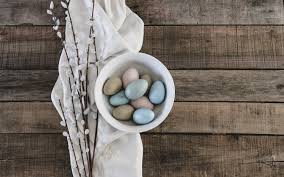
The egg (and all seeds) contains 'all potential', full of promise and new life. It symbolises the rebirth of nature, the fertility of the Earth and all creation. In many traditions the egg is a symbol for the whole universe. The 'cosmic' egg contains a balance of male and female, light and dark, in the egg yolk and egg white. The golden orb of the yolk represents the Sun God enfolded by the White Goddess, perfect balance, so it is particularly appropriate to Ostara and the Spring Equinox when all is in balance for just a moment, although the underlying energy is one of growth and expansion.
Many modern Pagans mark Ostara as a time of renewal and rebirth. Take some time to celebrate the new life that surrounds you in nature–walk in a park, lay in the grass, hike through a forest. As you do so, observe all the new things beginning around you–plants, flowers, insects, birds. Meditate upon the ever-moving Wheel of the Year, and celebrate the change of seasons.
This is a good time of year to start your seedlings. If you grow an herb garden, start getting the soil ready for late spring plantings. Celebrate the balance of light and dark as the sun begins to tip the scales, and the return of new growth is near.
With the goddess Ostara, her material is so scant that some scholars have speculated that she was not a goddess at all. Some scholars have also decided, rather randomly and on scant information, that Ostara is a form of Freya. Others believe that she is actually Iduna, or Walburga. Some modern Heathens and Norse Pagans have experienced personal gnosis of Ostara/Eostre being a Vanic goddess, or at least very close to the Vanir, which is why we list her in this section ... but again, there is no evidence and Ostara's origins continue to remain a mystery.
I also think it’s prudent to bring up here the story of the Roman god, Mithras. It is similar to the tale of Jesus Christ and his resurrection. Born at the winter solstice and resurrected in the spring, Mithras helped his followers ascend to the realm of light after death. In one legend, Mithras, who was popular amongst members of the Roman military, was ordered by the Sun to sacrifice a white bull. He reluctantly obeyed, but at the moment when his knife entered the creature's body, a miracle took place. The bull turned into the moon, and Mithras' cloak became the night sky. Where the bull's blood fell flowers grew, and stalks of grain sprouted from its tail.
As well there is the story of Attis. In ancient Rome, the followers of Cybele believed that their goddess had a consort who was born via a virgin birth. His name was Attis, and he died and was resurrected each year during the time of the vernal equinox on the Julian Calendar (between March 22 and March 25).
So, wether Ostara was a goddess or not, it is definitely a time to be celebrated and to rejoice over. After all, who doesn’t love the idea of winter coming to an end and the return of spring?

 Alberta Witches Association