
**Sages of Alberta**
Identifying the local sages of this province can sometimes be like a daunting task! So many names, nicknames and even misidentifying names! Here, I hope to give some clarity. I have updated the original post to refresh and bring attention back to it.
Whenever setting out to harvest any plant, all foraging should be done ethically and responsibly with taking no more than 25% of the plants your taking. And try cut the plant at a 45 degree angle. Also remember that mugwort (artemesia vulgaris) does not grow in the wild, here in Alberta.
• See labelled images below for visual identification
Big Sagebrush (Artemisia tridentata)

Description: Greyish, hairy, fragrant shrub, up to 2.5 meters tall with greyish brown peeling bark. Leaves are greyish green, 1-2 cm long and narrowly wedge shaped. Flower beads are yellow or brownish clusters. Covers many acres of dry land in prairies, foothills and mountain zones in BC and AB. This is the sage we most encountered in the Drumheller area.
Uses: often used in teas to treat colds, fevers and pneumonia, sore eyes and to ease childbirth. Wet leaves were used as a poltice to reduce swelling and infection. As food, sagebrush seeds can be quite bitter. The seeds were eaten raw or dried but usually ground into a meal and cooked with soups and stews. It also an excellent smoke cleansing sage and is a staple in any loose incense.
Prairie Sage; Prairie Sagewort (Artemisia ludovicana)
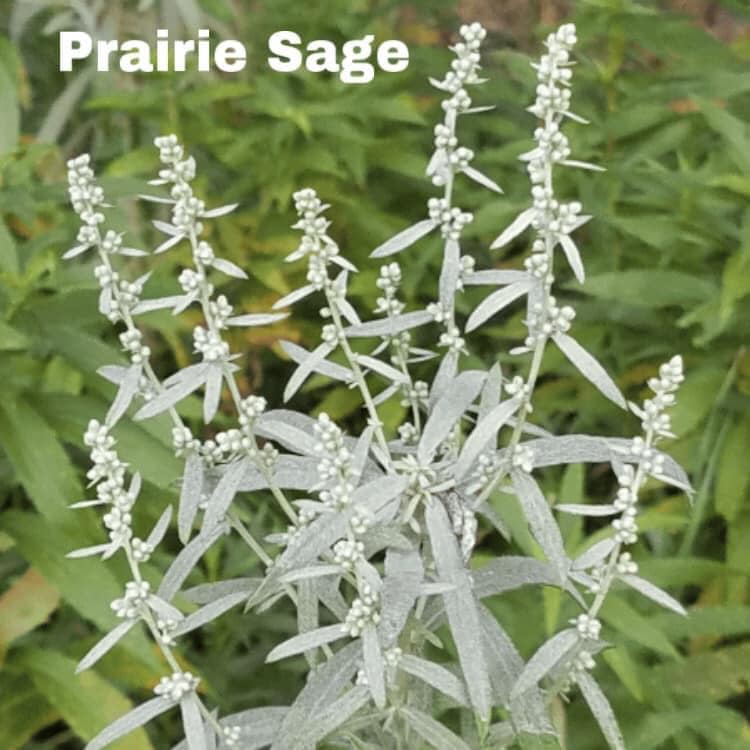
Description: habitat is grasslands and dry open area. Individual stems are 15-60cm tall, wolly-haired; aromatic when crushed; rootstock creeping. Leaves alternate on the stem and are oblong to lance-shaped. The florets are greyish white, producing eventual yellowish/brownish flowers along the top of the stalk.
Uses: The local Indigenous people’s used various parts of sage wort to treat stomach aches, sinus ailments, headaches, rheumatism and colds. This also makes for good smudging, smoke cleansing and incense when dries.
Long-Leaved Sage (Artemisia longifolia)

Description:: Eroded slopes, shale outcrops and badlands. I also encountered this particular sage in Drumheller. Stems are 30-120cm tall, shrubby, profusely branched; aromatic when crushed; surface with white wholly hairs. Leaves alternate on the branch, linear to lance-shaped, greyish green above and whitish below the leaves. The flower heads are spike-like, florets are yellow.
Uses: Can be used as a smoke cleanse, in bundles and incense
Absinthe Wormwood (Artemisia absinthium)


Description: waste areas and pastures, introduced from Europe as a garden plant. Stems are 20-100cm tall, silvery grey; sage like odours. Very bitter taste. Leaves are basal and alternate in a fan like hand-and-finger shape. Surface of the leaves are greyish green and wholly. Heads borne in a spike-like panicle. Florets are yellowish green.
Uses: Just like the name suggests, wormwood is made into absinthe. This plant is to be used with caution when ingested as can cause hallucinations and other sever symptoms. When burned wormwood is used to summon spirits as well as to develop psychic powers.
Pasture Sagewort (Artemisia frigida)

Description: Habitat is dry, south facing slopes, overgrazed pastures and prairie grasslands. We also encountered this in Drumheller and it was the softest feeling of all the sages. Stems are 10-16cm tall, silvery grey, branches and very aromatic and “sage-scented”. Florets are also yellow.
Uses: the Blackfoot chewed the leaves to relieve heartburn. They also used them to make a tea as a remedy for coughs and colds. Fresh leaves tossed into a campfire produce a pleasant fragrance.
Plains Wormwood (Artemisia campestris)

Description: habitat is dry prairies and open sandy areas. Stems are 30-60cm tall, smooth to hairy. Basal leaves that are crowded. Long stalk divided 2-3 times into narrow segments. Florets are yellowish green.
Uses: Couldn’t find sufficient information, but as with the Absinth Wormwood I would use extreme caution with ingestion. And the magical properties would be the same.
The Artemisia family is extensive and sometimes can be tricky to identify. If you have the ability to grow any of the above, I highly recommend it. All of these plants are strong spiritual plant allies and well worth the time and patience to get to know them. All these sages make for great alternatives to using white sage and offer the same smoke cleansing properties, as well as the magickal ones.
However you choose to use an Artemisia plant, be sure to spend some time with it under the Moon. 
Article by Amie Clark
 Alberta Witches Association