
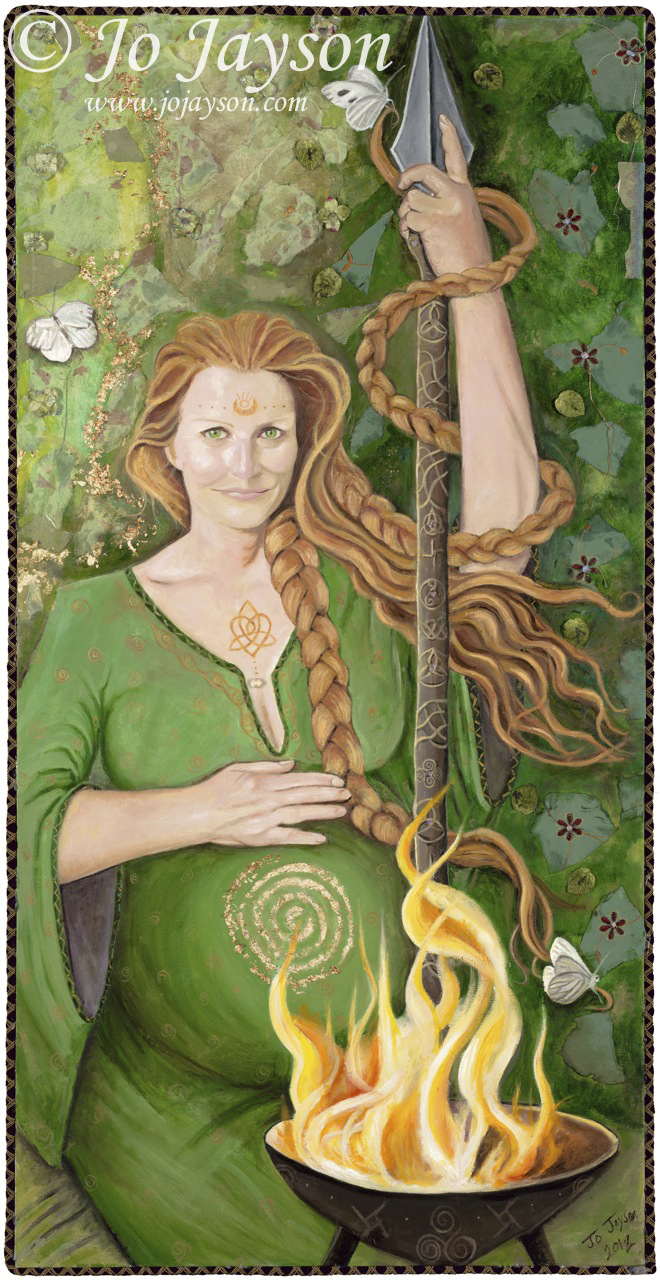
Brigid Mother Goddess of Ireland, © 2017 Jo Jayson (https://www.jojayson.com/)
“The deities of the Celtic pantheon have never been abstraction or fictions but remain inseparable from daily life. The fires of inspiration, as demonstrated in poetry, and the fires of the home and the forge are seen as identical. There is no separation between the inner and the outer worlds. The tenacity with which the traditions surrounding Brigid have survived, even the saint as the thinly-disguised Goddess, clearly indicates Her importance.”
– from Brigid: Survival Of A Goddess, by Winter Cymres (druidry.org)
There have been many texts written on the Irish Goddess Brighid and Her Christian counterpart, St Brigid of Kildare. Some believe the two are linked or even the same, that the Catholic Church merely folded the ancient Goddess into their stories, as they did with so many of the Pagan Gods, Goddesses, and traditions throughout the centuries.
Said to be the Goddess of Fire, Water, Poetry, Smithcraft, Peace, War, Motherhood, and Midwives, there are many variations on Brighid’s name – Brigid, Bride, Brigit, and sometimes, Brigantia, though some scholars believe that Brigantia is a separate Goddess. In any case, Her name means “the exalted one.”
Brighid is a Goddess of the Tuatha Dé Danann, and thought by some to be an aspect of the Goddess Danu. In some legends, Her mother is the River Goddess Boann; in others, it is the Morrigan, an interesting contradiction, which reflects Her Own contrasting nature as the Goddess of both Water and Fire, Peace and Warfare. Brighid is the daughter of the Dagda, sister of Aenghus, the wife of Bres, and the mother of Rúadán. When Her son was killed in battle, Brighid sang the first lament in Ireland, the keening (Irish: caoineadh), a Gaelic form of weeping that was traditionally performed at funerals in Ireland and also Scotland for over a thousand years.
Known as a Triple Goddess, there are said to be three Goddess sisters who all bear the name Brighid, or at least there are three aspects of Her. Some believe the Goddess of Winter Cailleach is a sister of Brighid, and that Brighid waits for the Goddess of the Underworld, Hekate, to pass the Torch to Her every January 31st, the night before Brighid arrives on Imbolc. Hekate is also sometimes referred to as Brighid’s sister.
Brighid’s Sacred Flame has long burned in Ireland, tended by an order of 19 Pagan priestesses or nuns at Kildare, until the order was disbanded after the Protestant Reformation. In 1993, the Brigidine Sisters returned to light the Sacred Flame, and it has been burning ever since. All over the world, Brighid’s Flamekeepers light candles for the Goddess.
Brighid is the Goddess to turn to for inspiration, creativity, and wisdom, or during childbirth. She roams the world in spring, and is said to be a Goddess of the Crossroads (possibly the reason She is sometimes connected to Hekate). Her Sacred Flame burns in the dark, through the winter, and in the light of the Sun. She is gentle, yet powerful, and will always be there for all who call upon Her name.
– by Ravenhawk Winters
References and further reading:
A Brigit of Ireland Devotional: Sun Among Stars, by Mael Brigde, © 2021 John Hunt Publishing
Brigid: History, Mystery, and Magick of the Celtic Goddess, Courtney Weber, © 2015 Weiser Books
The Spirit of the Celtic Gods and Goddesses: Their History, Magical Power, and Healing Energies, by Carl McColman and Kathryn Hinds, © 2020 Weiser Books
Pagan Portals: Gods and Goddesses of Ireland: A Guide to Irish Deities, by Morgan Daimler, © 2016 Moon Books
Brigid: Saint of Ireland, Once and Future Goddess, by Eliza Daley
Brigid: Survival Of A Goddess, by Winter Cymres
Brighid, Keening and a Time of Crisis by Jude Lally
 Alberta Witches Association